
RESIDENTIAL NOISE DISTURBANCE
Overview of relevant literature
Two main documents address “disturbing noise” in residential areas, in South-Africa Here follows a brief explanation of each’s relevance.
1. Noise Control Regulations, 1999 – Gauteng Province Gazette – 20 August 1999
The regulation is set out to: “provide a uniform minimum standard for noise regulation in the province; accommodate the specific circumstances of different neighborhoods and areas; and Create new mechanisms for effective enforcement in neighborhoods.”
Here follows relevant definitions that are used in the regulations and are relevant to this assessment.
- Ambient Sound Level: means the reading on an integrating impulse sound level meter taken at a measuring point in the absence of any alleged disturbing noise at the end of a total period of at least 10 minutes after such meter was put into operation.
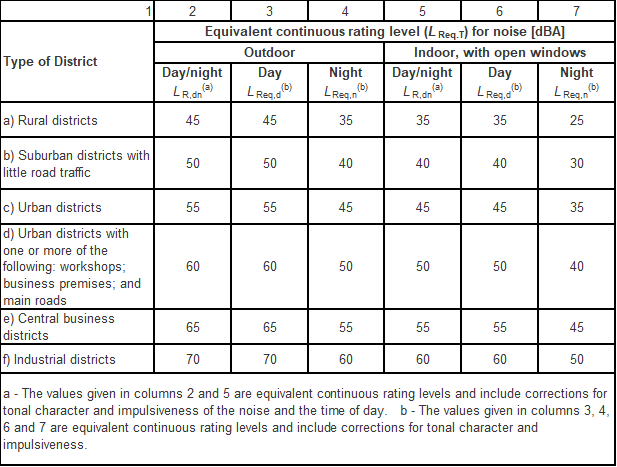
- Disturbing noise: means a noise level that causes the ambient noise level to rise above the designated zone level, or if no zone has been designated, the typical rating levels for ambient noise in districts in table 2 of SABS 0103. (Now SANS 10103:2008)
- Measuring Point: relating to –
- A piece of land from which an alleged disturbing noise emanates, means a point outside the property projection plane where an alleged disturbing noise shall be measured in accordance with the provisions of regulation 16;
- A building with more than one occupant, means a point in or outside the building where an alleged disturbing noise shall be measured in accordance with the provisions of regulations 16; and
- Sound Level Meter: means a device measuring sound pressure while it is set on F-Time weighting and indicates the results in dBA.
Part II on page 9 of the gazette outlines the Prohibition of Noise Nuisance:
9. No person shall –
- operate or play, or allow to be operated or played, a radio, television set, drum, musical instrument, sound amplifier, loudspeaker system or similar device producing, reproducing, or amplifying sound so as to cause a noise nuisance.
- offer any article for sale by shouting, ringing a bell or making other sounds or by allowing shouting, the ringing of a bell or making of other sounds in a manner which may cause a noise nuisance.
- …etc
2. SANS 10103:2008 (Edition 6) – The measurement and rating of environmental noise with respect to annoyance and to speech communication.
This standard cover methods and gives guidelines to assess working and living environments with respect to acoustic comfort, excellence, and with respect to annoyance from noise.
Here follows relevant points that are relevant to this assessment:
- Rating Level: a level that is the calculated result of the measured sound level over a period and has adjustments made for the following (or all) reasons:
- Distinct tonality,
- Impulsiveness,
- Daytime or night-time.
- Daytime is from 06h00 to 22h00, and night-time is from 22h00 to 06h00
- Rating levels for various district zones are provided for daytime, night time, and day/night-time periods. The table below shows the rating levels that should not be exceeded.
3. The decibel scale.
Sound pressure levels are provided in a logarithmical ratio scale indicated as decibels (dB). The threshold of sound is 0dB and the threshold of pain is 120dB. Average human speech 1m away is 60dB. Here are some relevant points on how to interpret changes in sound pressure levels:
- Inverse square law: In a free-field environment, with little to no reflective surfaces, sound levels reduce at a rate of 6dB per doubling of distance.
- Doubling the sound source: When there are two sound sources that produce the same sound levels individually, the combined result equates to a 3dB increase from just one sound source in operation.
Doubling of Loudness: The human response to “twice as loud” results in a 10dB change.